
Do any of these feel familiar?
Relaxing into receiving care is hard. You have a pervasive sense of being unworthy, too needy, or that you can’t trust your partner, even if they are trustworthy.
You have a hard time feeling emotions in your body and tend to live life “from the neck up.”
Your emotions feel “too big” for everyday situations. You feel “too sensitive” no matter how much therapy you do.
When people you are close to pull away or say no to your bids for connection, it feels catastrophic— not just disappointing.
You tolerate how your partner touches you, but you don’t really enjoy it.
During sex, you’re in your head— thinking, analyzing, planning— instead of feeling.
You’re not 100% sure you’re worthy of love, or you’re afraid that owning your vulnerability will be humiliating.
You’ve never experienced true attunement— that feeling of being completely seen and met.
Or maybe it’s more intense: You shut down during intimacy. Your body braces against closeness even when you’re safe. You struggle to ask for what you need or believe you deserve it.
Whether subtle or severe, these patterns live in your nervous system, not just your mind.
You might understand your childhood trauma intellectually—you can explain exactly why you are the way you are. But your body is still running the old protective patterns.
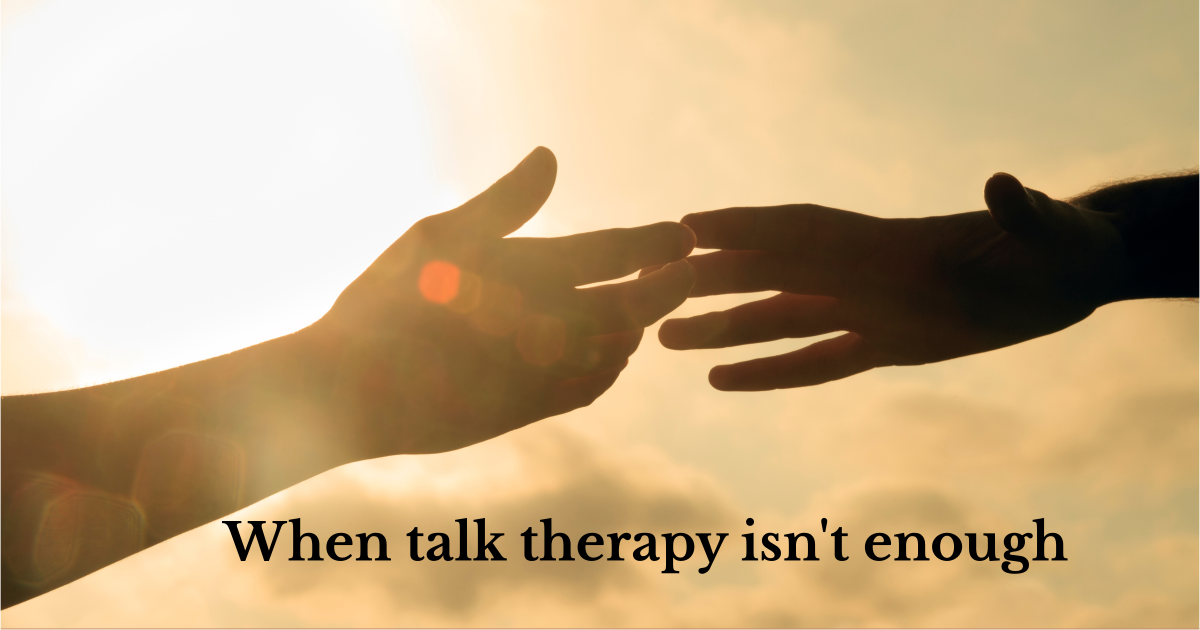
And talk therapy alone often can’t shift them.
NeuroAffective Touch (NATouch) is a somatic approach that bridges psychological insight and bodily experience. It uses attuned, consensual touch to help your body complete developmental experiences that were missed, heal from trauma, and learn new patterns of safety and connection.
Developed by Dr. Aline LaPierre, this approach has been transforming individual healing for decades through trained practitioners worldwide.
This isn’t massage. It’s not about relaxation or fixing muscle tension. It’s about addressing the places in your body that are still waiting—sometimes for decades—to finally tell their story.
Touch is your first language. Before you could speak, before you could even open your eyes, you were held and touched. The way you were touched (or not touched) as an infant told your body whether the world was safe, whether you were wanted, whether love could be trusted.
When that early touch was misattuned, absent, or abusive, your body learned protective patterns that may still be running today—even in the safest relationships, even when your mind knows better.
I work with individuals seeking to heal:
I also help couples apply NeuroAffective Touch principles in their partnerships to support each other’s healing and create deeper nervous system safety together.
NeuroAffective Touch sessions are gentle, fully consensual, and done at your pace. You remain clothed, and everything happens with explicit permission and ongoing communication.
This isn’t something that’s “done to” you. We work together to listen to what your body needs, meet it where it is, and create conditions for healing. My hands become a bridge between your body and mind, offering the attunement and safety your nervous system has been waiting for.
Sessions are integrated into longer-term coaching packages when useful, or available on request as standalone work.
I’m a Foundation Training graduate of the NeuroAffective Touch Institute (2024), trained directly in the methodology created by Dr. Aline LaPierre. I bring my background as a somatic intimacy coach, along with my own deep personal healing through this work, to support clients in accessing body-based healing.
If you’re curious about whether NeuroAffective Touch might be right for you, let’s talk.
Book a free consultation to discuss your specific needs and how this work might support your healing.
Or email me directly at laura(at)laurajurgens(dot)com with questions.
Q: Is this like massage?
No. While both involve touch, NeuroAffective Touch is specifically designed to address attachment wounds, developmental trauma, and nervous system patterns. It’s not about muscle tension or relaxation—it’s about helping your body complete interrupted developmental processes and create new patterns of safety.
Q: Will I need to undress?
No. You remain fully clothed during sessions. This work is about nervous system safety and healing, not physical manipulation.
Q: What if I’m nervous about being touched?
That’s completely normal and actually quite common. We go at your pace, with full consent at every step. Being nervous doesn’t disqualify you—it’s often a sign that this work could be valuable.
Q: How is this different from talk therapy?
Talk therapy works with explicit memory and cognitive understanding. NeuroAffective Touch works with implicit, body-based memory and nervous system patterns. Many people find they need both—the insight from therapy AND the body-based healing from somatic work.
Q: Can this help with sexual issues?
Yes, though we don’t work directly on sexual function. When your body heals from attachment wounds and learns to feel safe, sexual connection often naturally shifts. Many of my clients find that their capacity for intimacy, pleasure, and authentic desire deepens through this work.
Q: Do you work with couples?
Yes. I work with couples both in individual sessions (teaching partners how to support each other) and through the Thriving Together course I’m co-teaching with Dr. Aline LaPierre.
“The body remembers what the mind has forgotten. We use touch to support the body in finally telling its story.”
— Dr. Aline LaPierre